|
worry
|
|
home
- contents - obstacles
contents
|
|
There
are people who seem to make a life out of worrying,
who can't look at anything going on in their lives
without finding cause to think that the worst of
everything is going to happen, and that it's going
to happen to them or to those they love--or
both. But these people who worry so much are
forgetting some very important life lessons, the
most important of which is that worrying doesn't
change a single thing, doesn't help a bit.
So
why worry?
It's
easy to be concerned when someone is about to do
something risky. If one of my step-daughters
suddenly took off for a third-world country that's
plagued by violence without any extra money or
security measures, it would be very easy for me to
worry about her safety and well-being. There
would be many things that could happen to her, and
it would be easy to focus on those negative
possibilities and worry about her. But my
worrying wouldn't do a thing to change her
situation, and it would make me rather
miserable. And if she called to say hi and I
could only talk about how worried I was, I wouldn't
be able to support or encourage her at all.
If
I suddenly lost my job and didn't have any money in
the bank, I most definitely could worry about my
finances--I might end up losing my home and many of
my possessions, and I could go into debt and ruin my
credit rating.
|

|
|
But
my worrying wouldn't help the situation at all, and
it could negatively impact my health through the
stress and strife that I would experience.
Worrying
comes when we think of negative future
possibilities. It's that simple--we spend time
and energy thinking about negative things that could
happen, not that have happened. And therefore
the energy that were expending usually is wasted
because those negative things tend not to come about
after all. Mark Twain said that "I
am an old man and have known a great many troubles,
but most of them never happened,"
and most of us can relate to this statement.
Most of what we worry about never comes to pass, and
the time we spent worrying was time and energy
wasted.
And
even if the worst does come to pass, the worrying
didn't do a thing to help make it less difficult,
less intense, less negative. We might have
spent our time preparing for the outcome rather than
worrying about it, but instead we devoted our energy
to purely self-centered concern.
Worry
is a reflection of a lack of faith that life will be
good to us, a lack of faith that God and life are in
control and will make our lives full and
vibrant. Worry reflects a lack of faith in
oneself and in other people to do things that need
to be done when they need to be done, and a lack of
trust that we'll be able to deal with difficulties
when they surface in our lives.
Worry
keeps us from helping other people, it causes us
many negative results through the stress and strife
that it brings, and it wastes a lot of the precious
energy that we have in our lives. The only way
to combat worry, it seems, is through
acceptance--acceptance of the current situations in
our lives--and attempting to take positive action to
counter the effects of possible negative factors in
our lives. Worry doesn't change anything
except our own stress levels, and it's important
that we leave it behind as soon as we can if we wish
to live our lives and our todays fully and
completely.
* * *
The
history of the word:
Worrying may shorten one's life, but not as
quickly as it once did. The ancestor of our
word, Old English wyrgan, meant "to
strangle." Its Middle English descendant,
worien, kept this sense and developed the new
sense "to grasp by the throat with the teeth
and lacerate" or "to kill or injure by
biting and shaking." This is the way
wolves or dogs might attack sheep, for example.
In the 16th century worry began to be used in
the sense "to harass, as by rough treatment or
attack," or "to assault verbally,"
and in the 17th century the word took on the sense
"to bother, distress, or persecute."
It was a small step from this sense to the main
modern senses "to cause to feel anxious or
distressed" and "to feel troubled or
uneasy," first recorded in the 19th century.
(from Houghton Mifflin/Yahoo)
|
|
| |
|
A man ninety years old was asked to what he
attributed his longevity.
“I reckon,” he said, with a twinkle in his eye,
“it’s because most nights
I went to bed and slept when I
should have sat up and worried.”
Dorothea Kent |
| |
It is
not work that kills us; it is worry. Work is healthy
and you can
hardly put more upon a person than he or she can bear;
but worry is the rust upon the blade.
Henry
Ward Beecher |
| |
|
Mental problems feed
upon the attention you give them. The more you
worry about them, the stronger they become. If you
ignore them,
they lose their power and finally vanish.
Annamalai Swami |
| |
|
The
more we worry--the more we have something to worry about.
Tom Seeley |
| |
|

|
|
quotations
- contents
-
welcome
page
-
obstacles
our
current e-zine
-
the
people behind the words
-
articles
and excerpts
Daily
Meditations, Year One - Year
Two - Year Three
- Year Four
Sign up
for your free daily spiritual or general quotation ~ ~ Sign
up for your free daily meditation
|
| |
|

|
| |
Worry is like a rocking chair—it keeps you
moving
but doesn’t get you anywhere.
Corrie Ten Boom
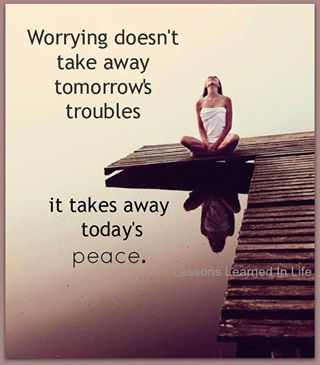
Worrying is carrying tomorrow's load with today's strength--
carrying two days at once. It is moving into tomorrow
ahead of time. Worrying doesn't empty tomorrow of its
sorrow, it empties today of its strength. |
| |
|
Death was walking toward a city one morning
and a man asked, "What are
you going to do
there?" "I'm going to take one hundred
people," Death replied.
"That's
horrible!" the man said. "That's the way it
is," Death said. "Well, we'll
see about
that," said the man as he hurried to warn everyone he
could about
Death's plan. As evening fell, he met
Death again. "You told me you were
going to take
one hundred people," the man said. "Why did
one
thousand die?" "I kept my word,"
Death answered. "I took
only one hundred.
Worry took the rest."
Contemporary spiritual story |
| |
There
is a great difference between worry and concern. A worried
person sees a problem, and a concerned person
solves a problem.
Harold
Stephens |
| |
|
There
is nothing that wastes the body like worry,
and one who has any faith in God should be ashamed
to worry about anything whatsoever.
Mohandas
Gandhi
|
| |
|
If
you can't sleep, then get up and do something instead of
lying there
worrying. It's the worry that gets you, not the
lack of sleep.
Dale
Carnegie
|
| |
I
believe God is managing affairs and that He doesn't need
any advice from me. With God in charge, I believe
everything
will work out for the best in the end. So what is there to
worry about?
Henry
Ford |
| |
|
Worry
a little bit every day and in a lifetime you will lose
a couple of years. If something is wrong, fix it if
you can.
But train yourself not to worry. Worry never fixes
anything.
Mary
Hemingway
|
| |
|
Worrying can serve an important purpose:
If we worry about something today, we
can take action to avert trouble in the future. Most of the time, however, we worry
about what is beyond our control, or about things that are trivial and unimportant.
Whenever I worry, I remind myself to step back and ask myself whether my worry
serves a purpose. If it does, then I should take action!
If, however, it does not, then
I need to label my preoccupation as unnecessary worry, and move on to other more
useful pursuits. Although it may be difficult initially to shift my focus away from worry,
I know that over time I will gain better control over what preoccupies me
and learn to move on when I engage in futile concern.
Tal Ben-Shahar
Choose the Life You Want |
| |
|
|
| |
Do
you remember the things you were worrying about
a year ago? How did they work out? Didn't you
waste
a lot of fruitless energy on account of most of them?
Didn't most of them turn out all right after all?
Dale
Carnegie |
| |
|
Worry not about the possible troubles of
the future; for if
they come, you are but anticipating and adding to their
weight;
and if they do not come, your worry is useless; and in
either
case it is weak and in vain, and a distrust of God's
providence.
Hugh Blair
|
| |
|
Anxiety
never yet successfully bridged any chasm.
Ruffini |
| |
|
|
| |
|
One
of the worst features about worrying is that it destroys our
ability to concentrate. When we worry, our minds jump here and
there and everywhere,
and we lose all
power of decision. However,
when we force ourselves to
face the worst and accept
it mentally,
we then eliminate all these vague imaginings
and put ourselves in a
position in which we are able to concentrate on our problem.
Willis H. Carrier |
| |
|
Remember that our fearful thoughts are exaggerated
and can
make the problem worse. A good way to
manage your worry
is to challenge your negative
thinking with positive statements
and realistic
thinking. When encountering thoughts that make
you fearful or anxious, challenge those thoughts by
asking yourself
questions that will maintain
objectivity and common sense.
When overwhelmed with worry, you may encounter a lot
of
scary thoughts coming at you all at once.
Instead of getting upset,
remember that these
thoughts are exaggerated and are not based
on
reality. From my interviews with various
professionals, I’ve learned
that usually it is the
fear behind the thoughts that gets us worked
up.
Ignore the fear behind these thoughts and
your worry should decrease.
Stanley Popovich
|
| |
|
Worries
cannot be willed away by consciously refusing to acknowledge
them--they must be pulled up by the roots and examined in the light,
not
pushed deeper into the unconscious where they only do darker mischief
by disguising themselves in some bizarre manner.
Sydney J. Harris
|
| |
|
Nothing is so
wretched or foolish as to anticipate misfortunes.
What madness is it to be expecting evil before it comes.
Seneca |
| |
|
Worry is one of those
"hamster wheels" of our lives, offering us the
opportunity to live through terrible things that never happen. When
we
stop to catch our breath, we might ask ourselves, "Why pre-worry?"
"Why
live through something that hasn't happened and may never
happen?" Do
we actually believe that worry practice will make us better prepared?
Remember, everything has a beginning and an ending. We
only need to
deal with situations in our lives as they are happening, not before.
Today's
disasters may tomorrow or next week be seen as one of life's gifts.
All we have to do is deal with what is in front of us.
Anne Wilson Schaef
Meditations for Living in Balance |
| |
|

|
We
have some
inspiring and motivational books that may interest you. Our main way of supporting this site is
through the sale of books, either physical copies
or digital copies for your Amazon Kindle (including the
online reader). All of the money that we earn
through them comes back to the site
in one way or another. Just click on the picture
to the left to visit our page of books, both fiction and
non-fiction! |
|
| |
You can think about your problems or you can
worry about them, and there is
a vast difference between
the two. Worry is thinking that has turned toxic.
It is jarring music that goes round and round and never
comes to either
climax or conclusion. Thinking works its
way through problems
to conclusions
and decisions; worry
leaves you in a state of tensely
suspended animation.
When you worry, you go over the same ground endlessly
and
come out the
same place you started. Thinking makes
progress from one place
to
another; worry remains static. The problem of life is to change worry
into thinking and
anxiety into creative action.
Harold B. Walker |
| |
|
How
often are you worrying about the present moment? The
present
moment is usually all right. If you're worrying,
you're either agonizing
over the past which you should have forgotten long ago, or
else you're
apprehensive over the future which hasn't even come
yet. We tend to
skip over the present moment which is the
only moment God gives any of us to live.
Peace
Pilgrim |
| |
|
Worry is like a
microscope. It makes every little misery look huge.
We can use a telescope, and see far away into life. We
shall see
much, but worry we shall hardly notice. We shall find
it so small.
Nicholas Rodney |
| |
|

|
|
quotations
- contents
-
welcome
page
-
obstacles
our
current e-zine
-
the
people behind the words
-
articles
and excerpts
Daily
Meditations, Year One - Year
Two - Year Three
- Year Four
Sign up
for your free daily spiritual or general quotation ~ ~ Sign
up for your free daily meditation
|
| |
Worry is
an infirmity; there is no virtue in it. Worry is
spiritual
nearsightedness; a fumbling way of looking at little things
and magnifying their value.
Anna Brown Lindsay |
| |
|
Worry
is a thin stream of fear trickling through the mind.
If encouraged,
it cuts a channel into which all other thoughts are drained.
Arthur S. Roche |
| |
|
Worry is the
interest which we pay on trouble before it comes,
and we attract trouble every time we worry about it.
Albert E. Cliffe |
| |
I have also learned that patience and time have a way
of
resolving our troubles. When I am worried about
something,
I try to see my troubles in their proper
perspective. I say
to myself: "Two months from
now I shall not be worrying
about this bad break, so why worry
about it now? Why not
assume now the same attitude that I
will have two months from now?"
William Lyon Phelps
|
| |
|
My philosophy is that worrying means you
suffer twice.
J.K. Rowling
(Newt Scamander in Fantastic Beasts) |
| |
|

|
|
|