|
More
from and about
Peace Pilgrim
(biographical info at bottom of page) |
|
|
| |
|
If you want
to serve the universe, the obvious place to begin is right where
you are. That's where I began. I looked at every situation I came
into and
wondered, 'What can I do to be of service in this situation?'
Sometimes
there was nothing I could do, but often there was - a helping
hand, a word
of cheer, a pleasant smile. Then, after I had given a lot, a most
wonderful
spiritual receiving began - giving me more to give. |
| |
|
If you are harboring the
slightest bitterness toward anyone,
or any unkind thoughts of any sort whatever, you must get rid
of them quickly. They are not hurting anyone but you. It
isn't enough
just to do right things and say right things--you must also think
right things before your life can come into harmony.
Unnecessary
possessions are unnecessary burdens. If you have them, you have to
take care of them! There is great freedom in simplicity of living.
It is those who have enough but not too much who are the happiest.
|

|
| |
|
In reality, of course, we are
all cells in the body of humanity. We are not separate from our fellow humans.
The whole thing is a totality. It's only from that higher viewpoint that you
can know what it is to love your neighbor as yourself. From that higher
viewpoint there becomes just one realistic way to work, and that is for the
good of the whole. As long as you work for your selfish little self, you're
just one cell against all those other cells, and you're way out of harmony. But
as soon as you begin working for the good of the whole, you find yourself in
harmony with all of your fellow human beings. You see, it's the easy,
harmonious way to live.
|
| |
|
There is a
well-worn road which is pleasing to the senses and gratifies
worldly desires, but leads to nowhere. And there is the less
traveled path, which requires purifications and
relinquishments, but results in untold spiritual blessings.
|
| |
|
Truth
is the pearl without price. One cannot obtain truth by buying
it--all you can do is to strive for spiritual truth and when one
is ready, it will be given freely. Nor should spiritual truth be
sold, lest the seller be injured spiritually. You lose any
spiritual contact the moment you commercialize it. Those who have
the truth would not be packaging and selling it, so anyone who is
selling it, really does not possess it.
|
|
| |
|
It's very important to get your desires centered
so you will
desire only to do God's will for you. . . . When you think about
it,
is there anything else as really important to desire? |
| |
|

|
|
quotations
- contents
-
welcome
page
- obstacles
- weblog
the
people behind the words
- our
current e-zine
- articles
and excerpts
Daily
Meditations, Year One - Year
Two - Year Three - Year
Four
Simple
and Profound website
Sign up for your free email daily
spiritual or general quotation
Sign
up for your free email daily meditation |
| |
|
You
must learn to forgive yourself as easily as you forgive others.
And then take a further step and use all that energy that you
used in condemning yourself for improving yourself. |
| |
|
I’ve
met a few people who had to change their jobs in order to
change their lives but I’ve met many more people who merely had
to change their motive to service in order to change their lives. |
| |
|
Were
I to solve problems for others they would remain stagnant;
they would never grow. It would be a great injustice to them. My
approach is to help with cause rather than effect. When I help
others, it is by instilling within them the inspiration
to work out problems by themselves. |
| |
|

|
| |
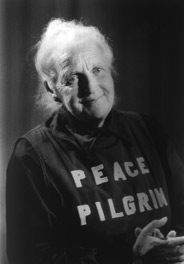
Carrying in her tunic
pockets her only possessions--toothbrush, comb, pen, and later, her Steps
to Inner Peace pamphlets--she took a vow to walk penniless, and
to remain a wanderer until mankind had learned the way of peace,
"walking until given shelter and fasting until given
food." She had no organizational backing and never
accepted money. She owned only what she wore on her
back. She stepped out for peace on faith alone, and in so
doing, undertook a daring and groundbreaking feat that represented
enormous moral courage.
She introduced herself to people as a pilgrim--walking not to a
place but for an idea. Her message was a simple
one about the way to peace. She said to all who would
listen: "This is the way of peace: Overcome evil
with good, falsehood with truth, and hatred with love."
Her definition of peace included peace among nations, among people
and individuals, and the most important peace--within oneself--for
only with inner peace, she believed, can the other kinds be
achieved. She said that her message should not be taken
lightly, or viewed simply as impractical religious concepts, but
rather, as universal truths to be lived:
These are
laws governing human conduct, which apply as rigidly as the law of
gravity. When we disregard these laws in any walk of life
chaos results. Through obedience to these laws this world of
ours could enter into a period of peace and richness beyond our
fondest dreams.
Setting out at the
dawn of the nuclear age, she carried three petitions: one to end the
war in Korea, the second to establish a U.S. Peace Department (both
directed at President Eisenhower and Congress); and a third petition
directed at the United Nations, urging world disarmament and the
redirection of arms spending towards human needs funding. She
delivered all three.
On her journeys, she preached that the basic conflict in the world
was not between nations, but between two beliefs: 1) that evil
can only be overcome with more evil (the dominant, present belief);
and 2) that evil can only be overcome with good (the belief for
which she walked). "What we suffer from in the world is
immaturity," she said. "If we were mature people,
war would be unthinkable and peace would be assured." In
her life, her belief in maturity was put into daily practice.
She wrote:
No one walks
so safely as one who walks humbly and harmlessly with great love
and great faith. For such a person gets through to the good
in others (and there is good in everyone), and therefore cannot be
harmed. This works between individuals, it works between
groups and it would work between nations if nations had the
courage to try it.
She walked for the
next 28 years, weaving back and forth across the country, making
trips into neighboring countries. From the start, her life on
the road-- walking, talking, eating, sleeping--was undertaken as a
reverent, loving prayer, integrating what she believed were the
important things of living, into a penniless, simple, committed
existence of love and service.
She never approached anyone, but waited for people to approach
her. Her commitment was to make herself available to the
serious, the concerned and the curious. She spoke tirelessly
to those who wanted to talk. With her message covering the
entire peace gamut, from the international to the individual, she
asked people to overcome the selfishness and pride within themselves
first, and then do whatever they felt called to do for peace in the
world.
For those who asked, she gave out her Steps Toward Inner Peace
pamphlet, which outlined her preparations for inner peace, including
simplification of life and purification of the body, bringing the
inner and outer well being into harmony. She always stressed
that there was no particular order to the steps, but rather, one
should begin wherever it made sense. (These Steps were
first printed in 1966, when, during a radio interview, a friend
asked her to share them with listeners. The friend copied them
down and made a little booklet, Steps Toward Inner Peace,
which has been in print ever since).
(Taken from peacepilgrim.net. Read her full bio--an amazing
story-- at peacepilgrim.org.
You'll find more information and free copies of her writings there,
also.)
|
| |
|
|
| |
|
|
We
have some
inspiring and motivational books that may interest you. Our main way of supporting this site is
through the sale of books, either physical copies
or digital copies for your Amazon Kindle (including the
online reader). All of the money that we earn
through them comes back to the site
in one way or another. Just click on the picture
to the left to visit our page of books, both fiction and
non-fiction! |
|
| |
|

|
|