In
those moments when we forget ourselves-- not thinking, "Am I
happy?", but completely oblivious to our little ego--we spend
a brief but beautiful holiday in heaven. -
Eknath
Easwaran
The
real secret of happiness is simply this: to be willing to
live and let live, and to know very clearly in one's own mind that
the unpardonable sin is to be an unpleasant person.
-
Galen
Starr Ross
It
is one of the most beautiful compensations of this life that no one can
sincerely try to help another without helping him- or herself.
-Ralph
Waldo Emerson
And the day
came when
the risk
to remain tight
in a
bud
was more
painful
than the risk it took to blossom. -
Anaïs Nin
Many
of us don't know what to ask for. Either we
don't know what is available to us because we have
never been exposed to it, or we are so out of touch
with ourselves that we no longer are able to perceive
our real needs and wants. Some of us have become
so numbed out that we are simply unaware of our
natural yearnings and desires. We no longer know
what we really want.
Most
of us don't know how to ask. We have never
learned the technology of making an effective
request. We have not seen these effective
communication skills modeled in our homes and we were
not taught them in our schools or at work.
Many
of us don't know whom to ask and when to ask. We
have not learned how to identify likely prospects who
can deliver what we ask for whether it be a hug, sage
advice, or an order for something we are
selling. And many of us have never learned to
read the nonverbal cues that people send us that tell
us "I'm with you" or "not now."
2.
Limiting and Inaccurate Beliefs
The
second barrier to asking for what we want are the
limiting and negative beliefs that have been
programmed into our subconscious and which now
silently control all of our actions.
We
are born with an empty data bank that has to be
programmed. Many of us are hindered in our
asking for and getting what we want by the negative
and limiting beliefs we have taken on from our
parents, teachers, churches, peers, and the
media. We can become constricted and even
paralyzed by this parental and cultural conditioning.
We
are taught that it is better to give than to receive;
that if he really loved me, I wouldn't have to ask;
and that being needy is a weakness. We have
learned from our failures and our traumatic
experiences in life that if you don't want too much,
then you won't be disappointed; don't expect too much
from men like your father; and it is safer to keep
your mouth shut and appear the fool, than to open it
and remove all doubt.
3.
Fear
As
a result of the negative, painful, and shameful
experiences of our childhood, we become afraid to
participate, afraid to go after those things we truly
want and desire. We become afraid of rejection,
looking foolish, losing face and being vulnerable and
hurt by others. As a result of those fears, we
become passive. We settle for less than we
really want and we sit in judgment of others who are
getting what we want. We don't have the courage
to ask for or the self-discipline to create. We
end up using all of our energy to protect ourselves
against boogey men we have created in our minds
instead of using those energies to create what we
want.
We
face fears such as the fear of rejection, the fear of
looking stupid, the fear of being powerless, the fear
of humiliation, the fear of punishment, the fear of
abandonment, and the fear of endless obligation.
4.
Low Self-Esteem
According
to several recent studies, only one out of three of us
has high self-esteem. "Look to your right
and look to your left. Only one of you is
okay!" is the standard line we use in our
seminars. One out of three! We are
suffering from a national epidemic of low self-esteem.
Most
of us feel unworthy of love, happiness and fulfillment
and inadequate to create the kind of life we
want. We suffer from inferiority complexes,
neurotic guilt, and a lack of self-confidence.
As a result, we don't believe our needs and wants are
important and worthy of pursuing. We become
codependent from our belief that other people's needs
are more important than our own--especially the needs
of men, our children, our aging parents, our boss, the
homeless, and the needy. We sacrifice our own
fulfillment on the altar of taking care of others.
5.
Pride
Many
of us, especially men, get stuck in our pride.
We become too arrogant to admit we need anyone or
anything. We will not stop to ask for
directions, advice, or help. We are convinced we
need to do everything ourselves--usually perfectly and
usually on the first try--or we risk the loss of
respect, friendship, and our own sense of adequacy.
~
~ ~ ~ ~
Think
of the benefits of knowing how, when, and whom to ask
for everything you want: fewer disappointments
in relationships, more effective team efforts at work,
cleaner negotiations at the bargaining table, the
money you need to start a business, fewer fights with
your parents and children, the extra instruction and
support you need, less suffering in the silent despair
of loneliness, and the causes you support receiving
funding they need to continue their good works.
Literally a whole new world can open up to you and
everyone you care about.
You
can ask for a hug, comfort, listening, forgiveness,
attention, time, intimacy, caring, respect, love,
nurturing, a massage, healing energy, prayers, an
explanation, loyalty, sexual fidelity and a 100
percent commitment.
You
can ask for a helping hand around the house, a favor,
someone to keep a secret, help with your homework, the
loan of a sweater or jacket, private tutoring,
information, help with a project, your kids'
cooperation, someone to baby-sit, swimming lessons,
money for the movies, participation in a car pool,
help with a flat tire, the loan of the family car or
compliance with rules.
Don't
wait until everything is just right. It will
never be perfect. There will always be
challenges, obstacles, and less-than-perfect
conditions. So what? Get started
now. With each step you take, you will grow
stronger and stronger, more and more skilled, more and
more self-confident and more and more successful.
Everything
you want is out there waiting for you to ask.
Everything you want also wants you. But you have
to take action to get it. The time for dreaming
is over. It is time to get up and start asking
for what you want. Start slowly and build up;
jump right in and start with bold and outrageous
requests. Either way is fine. Do what
feels right for you. Just get started.
We
have some
inspiring and motivational books that may interest you. Our main way of supporting this site is
through the sale of books, either physical copies
or digital copies for your Amazon Kindle (including the
online reader). All of the money that we earn
through them comes back to the site
in one way or another. Just click on the picture
to the left to visit our page of books, both fiction and
non-fiction!
We
talk a lot about living life to our fullest
potential, about being our best self. For many of
us, it's the primary goal and focus of our life, to
be the absolute best we can be, right here,
right now. The most intriguing part of the process
to me is that it is a moving target. As good as I am
right now, and in fact, I am the best I've ever
been, I know I can continue to evolve and be even
better.
Sometimes
in the journey, we get stuck at a particular place.
Here are 10 signals you're not living to your
fullest potential right now and some ideas for
moving out of these "stuck" places.
1.
You find yourself using phrases such as "I wish
I could," "If only," "I really
ought to," "I should do," "As
soon as (I lose weight, find another job, find a
mate)." If thoughts control who we are,
then words are the primary tool we have to redefine
ourselves. The more you repeat the phrases above,
the less energetic and more powerless you feel.
Antidote:
Find new, powerful words to replace the ones that
are bringing you down. A very powerful phrase is
"For whatever reason, I am currently choosing
to (or not to) xxx." No matter what the
action you are doing or not doing, the moment you
acknowledge it's a choice, you put yourself in a
position of power. You also put yourself in a
position to make a new choice.
2.
You feel overwhelmed, overworked, undervalued and
under-appreciated. In fact, you feel like a
victim. It seems like things are being done
"to" you
(or a group of people you belong to) and
nobody appreciates you.
Antidote:
These feelings springs from a sense
of scarcity, so the best antidote is to start feeling
grateful. Once you begin to feel truly, sincerely grateful for
all the gifts you do have in your life (and everything in
your life is a gift), your energy levels increase and you
start enjoying your life again. Don't forget to feel grateful
for yourself, your strengths and abilities, what makes you
uniquely you.
3.
You need to buy a new bookshelf just for
your self-help books. I smile as I write this, since I probably have
one of the best collections around. It's not so much that
you have a large library, but that you are constantly
seeking for a magic answer, for the one single piece of
information that is going to lift you up and put you back on
the road to being your best self.
Antidote:
Go within. Use meditation, journal
work and prayer to seek the answers that are already within
you. Use the writings of others as starting points if you
will, but recognize that their writings are the answers
they came up with when they went inside themselves.
Start
with five minutes twice a day if that's all you have, but the
peace you are looking for already exists within you.
Become
friends with it once again. The easiest tool I can
recommend for this is the 3-Breath Miracle. Engage your mind in
following your breath for three long, deep, slow breaths, holding
them as long as possible and expelling air when you exhale.
Pay attention to how you feel once you do this completely.
This is the energy you are going for.
4.
The only reason you go to work is to keep a
roof over your head and food on the table.
This has nothing to do with the nature of the
work you do, but with how you feel about how you are using
your gifts and talents, and whether or not you feel you are
doing the best job you possibly can. Do you feel respected at
work? Do you respect the work that others do around you?
Antidote:
Remember that people around you
primarily serve as mirrors for how you feel about yourself.
When
you start giving 100% of yourself at work, when you
strive for excellence in all you do, and when you value
your contribution to the team/effort, others will
start reflecting that back. You cannot find work
that you love if you can't find the joy in the work that you
currently do. Again, it starts from within.
5.
You don't have a clear sense of who you are
or what you stand for. You find it difficult to make choices and you
feel like you are drifting from one life situation to
another. What seems important one day seems inconsequential the
next.
Antidote:
Identify your values. When you know
what you truly hold important in this life and allow yourself
to make choices in alignment with those values, you
gain tremendous freedom in your life. Being true to what you
believe in is very liberating. A simple way to get some
clarity is to ask yourself "What do I want to role-model for
others?"
If this confuses you because you thought you
were clear about your values and what is important to
you, you may be in a transitional mode where the priorities of
your values are shifting. This happens at different times
in our lives as we mature, get older and experience
different life events. For example, having children is a time
that many of us experience a shift in our priorities, as is
getting older and experiencing health problems.
As a rule,
allowing yourself to be "in the present" and seeing
that you are not giving up on a value, but reassigning it a
number will do much to let go of the confusion.
6.
You are more worried about being right than
about being happy. This is an easy game to get caught up in.
We
often look for life experiences that vindicate our opinions,
and not the other way around. The lure of being
"right" is
very seductive and it is very easy to sabotage
yourself with this game.
Antidote:
Ask yourself "Where in my life am I
letting my need to be right to take over? Am I willing to
let go of being right? Am I willing to be happy?
What
would it look like to be happy instead of being
right?" The
key point here is being willing to choose being happy over
being right. Once you make that choice, you will start to
notice where your need to be right is getting in the way.
7.
Before you go to sleep at night, you find
yourself wishing you had spent your day doing something
other than what you did. If you find yourself doing this on a
consistent basis, it's time to look at the choices you are making.
Also, this is different from not getting to something you
meant to do because something else required your
attention. This is about doing non-productive things on a regular
basis, then wishing we'd done something else.
Antidote:
There are two suggestions for this
item. The first is to not wait until you go to bed to review
how you spent your time. Look at what you are doing on an
hourly basis. The other suggestion is, once you are looking
at this hour, make a conscious choice about what you want to
be doing. You can choose to watch TV or play on the
computer, but at the end of the day you will be able to honestly
say you did what you wanted to do. You can also try to spend
five or ten minutes of each hour doing something that will make
you feel good to get done. Allow yourself to build on small
successes.
8.
You spend a lot of time doing things that
keep your mind occupied (so you don't have to think about
you). While related to number seven, this is the actual
activity that keeps you from producing your best effort.
When we are really determined to sit on our greatness, we
usually don't get to the point of wishing we'd done
something different. The primary focus of this activity is to not
think about you or your life. Therefore, it must engage our
mind and keep it occupied. It might be TV, the computer, the
news, what the neighbors are doing, anything that can grab
us and keep us.
Antidote:
Many of these activities are
designed to deaden the thoughts that make you uncomfortable (see
number one). Often, when we get tired of the negative
messages, our first response is to try to stop thinking.
The more
we don't think, the more energy we need to spend on not
thinking. Some down-time is good, even essential.
The
key here is when big chunks of time are lost to these
activities. The first thing to do is to give yourself permission to
do the activity you are doing. Again, it's bringing
it into the realm of choice. Then, let yourself make
different choices from time to time.
9.
You feel an underlying sense of sadness
(when you let yourself feel). Part of the reason
we don't want to let ourselves think or feel
is that we are afraid we will be overwhelmed by the sadness. We are petrified to go down that
road.
Antidote:
If you feel sadness, something is
going on and it is critical to release the tears.
Give
yourself an opportunity to cry in a safe environment.
For
example, although we may not be able to give ourselves
permission to cry about what we need to cry about, we can
cry while watching a sad movie. One of my favorite
movies to use for this purpose is "Pay it
Forward," but you
probably have your own favorite. It's really important to free
yourself from this emotion, and allowing it out is actually
the way to not being overwhelmed by it. Once you allow the
tears, don't be surprised if you have a real burst of energy.
10. You keep all conversations at a
superficial level. Safe topics are the weather, the news, TV and
movies. If you find yourself steering all
conversations away from you, you may be in emotional hiding.
Antidote:
Find an outlet so that you can allow
yourself to go inwards safely. Try journal writing,
writing a letter to God, or some other format for getting in touch
with what's going on.
Louise was a life coach and inspirational
writer who passed away in 2011. Rest in
Peace, Louise!
Living
Life Fully, the e-zine
exists to try to provide for visitors of the world wide web a
place
of growth, peace, inspiration, and encouragement. Our
articles
are presented as thoughts of the authors--by no means do
we
mean to present them as ways that anyone has to live
life. Take
from them what you will, and disagree with
whatever you disagree
with--just know that they'll be here for you
each week.
Agape
means love for another self not because of any lovable qualities
which
he or she may possess, but purely and entirely because
it is a self
capable of experiencing happiness and misery
and endowed with the
power to choose between good and evil.
The love of humans is
thus more than a feeling, it is a state of the will.
Imagine
life as a game in which you are juggling five balls in the air.
You name them Work, Family, Health, Friends and Spirit, and you
are keeping all of them in the air. You will soon understand
that Work is a rubber ball. If you drop it, it will bounce
back. But the other four balls--Family, Health, Friends and
Spirit--are made of glass. If you drop one of these, they
will be irrevocably scuffed, marked, nicked, damaged or even
shattered. They will never be the same. You must understand that
and strive for balance in your life.
How?
1. Don't
undermine your worth by comparing yourself with others. It is
because we are different that each of us is special.
2. Don't
set your goals by what others deem important. Only you know what
is best for you.
3. Don't
take for granted the things closest to your heart. Cling to them
as you would your life, for without them, life is meaningless.
4. Don't
let your life slip through your fingers by living in the past or
for the future. By living your life one day at a time, you live
all the days of your life.
5. Don't
give up when you still have something to give. Nothing is really
over until the moment you stop trying.
6. Don't be
afraid to admit that you are less than perfect. It is the fragile
thread that binds us each together.
7.
Don't be afraid to encounter risks. It is by taking chances that
we learn how to be brave.
8.
Don't shut love out of your life by saying it's impossible to
find. The quickest way to receive love is to give; the fastest way
to lose love is to hold it too tightly; and the best way to keep
love is to give it wings.
9.
Don't run through life so fast that you forget not only where
you've been, but also where you are going.
10.
Don't forget that a person' s greatest emotional need is to feel
appreciated.
11.
Don't be afraid to learn. Knowledge is weightless, a treasure you
can always carry easily.
12.
Don't use time or words carelessly. Neither can be retrieved.
Life
is not a race, but a journey to be savoured each step of the way.
It
is the privilege
of adults to give advice.
It is the privilege of
youth not to listen.
Both avail themselves
of their privileges, and
the world rocks on.
D. Sutten
An
Irish Blessing
May your joys be
as bright as the morning,
and your sorrows merely be shadows
that fade in the sunlight of love.
May you have enough happiness to keep you sweet,
Enough trials to keep you strong,
Enough sorrow to keep you human,
Enough hope to keep you happy,
Enough failure to keep you humble,
Enough success to keep you eager,
Enough friends to give you comfort,
Enough courage and faith in yourself to banish sadness,
Enough wealth to meet your needs,
And one more thing:
Enough determination to make each day
a more wonderful day than the one before.
People
take care that
their neighbor shall
not cheat them.
But a
day comes when they begin
to care that they do not
cheat their neighbor.
Then all goes well. They
have changed
their market-cart into
a chariot of the sun.
Yes, life
can be mysterious and confusing--but there's much of life that's
actually rather dependable and reliable. Some principles apply
to life in so many different contexts that they can truly be called
universal--and learning what they are and how to approach them and use
them can teach us some of the most important lessons that we've ever
learned.
My doctorate is in Teaching and Learning. I use it a lot when I
teach at school, but I also do my best to apply what I've learned to
the life I'm living, and to observe how others live their lives.
What makes them happy or unhappy, stressed or peaceful, selfish or
generous, compassionate or arrogant? In this book, I've done my
best to pass on to you what I've learned from people in my life,
writers whose works I've read, and stories that I've heard.
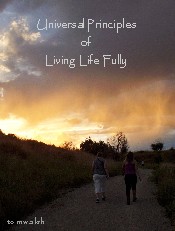
Perhaps these principles can be a positive part of your life, too! Universal Principles of Living Life Fully. Awareness of
these principles can explain a lot and take much of the frustration
out of the lives we lead.
Explore all of our
quotations pages--these links will take you to the first page of each
topic, and those pages will contain links to any additional pages on
the same topic (there are five pages on adversity, for example).






 ™
™