Hello,
and welcome to our our
first issue
of our new autumn. We hope
that this season
finds you doing well, and
that you're able to make the
most of the next three
months as the world
goes through its
annual series of beautiful,
breathtaking changes!
Flowers
do not force their way with great strife. Flowers
open
to perfection slowly in the sun. Don't be in a
hurry about
spiritual matters. Go step by step, and
be very sure. -
White
Eagle
Acceptance
is not submission; it is acknowledgement
of the facts
of a situation, then deciding
what you're going to do about it. -
Kathleen
Casey Theisen
To try to extinguish the drive for riches with money is
like trying to quench a fire by pouring butterfat over it.
-
Hindu proverb
All prosperity begins in the mind and
is dependent only upon the
full use
of our creative imagination. -
Ruth Ross
Take
a Deep Breath, Decide to Enjoy Life, and Feed the
Birds
Brian Dickinson
Time to take a deep breath — a deep breath, then pause.
There. Feel better already, don't you? Close
your eyes. Tight. Count to 10. Slowly.
Afterwards — eyes still closed, mind you — think of a
particularly upbeat something that you did this
year. Call up an image of this episode. Why is
it memorable? How long will you remember?
You say this year hasn't been an especially upbeat year
for you? That happens. No problem. Go
back two, three years — more if you need to — until
you come upon an image that makes you smile. The
important thing is to stay in the game.
When in doubt, feed the birds.
Write a letter. The exercise will benefit your
immortal soul and absolutely floor the recipient, who
probably hasn't received a letter from anyone since Earl
Butz was secretary of agriculture. Teach yourself to
tie a few good knots. While you're at it, knit up the
raveled sleeve of care. Allow ten minutes extra for
everything. When worried, just remember the words of
Bernard de Clairvaux: "Hey, babe, chill. Things
could be worse."
Feed the birds.
Listen
as the tea kettle whistles. Watch it steam up the
kitchen windows.
Write down Grandmother's recipe for
potato pancakes Parmesan, before you lose it again.
Avoid throngs. Laugh out loud when you feel like
it. For one day, leave your wristwatch at
home. Learn to whittle; throw shavings into the
fireplace, where they will do some good.
Break the mold.
Drive a different route to work. Say "good
morning" to those glowering faces in the elevator
(don't worry: Most people don't bite). Be
aware of the fact that that rock salt on sidewalks can
kill grass. Watch dawn arrive; see how many colors
the sky turns.
Take a deep breath.
Count your blessings.
Harboring a grudge against someone? Has it
helped? (Didn't think so.) Sing, if only in
the shower. Get older family members to tape their
reminiscences. Wiggle your toes. Next time you
make chili, add extra spice. Whistle while you
work. Go for a good long walk; stretch those legs,
including those important Achilles tendons, so easily
forgotten in the hectic pace of today's living.
Take the dog.
Remember what my father used to say. When I was a
boy, and about to head off somewhere or other, my father
always used to say, "Don't do anything dumb!"
Remember to feed the birds.
Take a chance now and then. Look for a new
friend.
Telephone an old friend. Seize the moment.
Believe in yourself. If you keep kicking yourself,
you're going to fall down. Davey Crockett, he of the
long rifle and wild frontier, said: "Make sure
you're right, then go ahead," which put it nicely.
A carpenter says: "Measure twice, cut
once."
Take your choice.
Breathe deeply. Let your memory slip back to that
summer when you were quite small, at the beach with your
family, and your father hoisted you onto his shoulders and
waded into the lake until his knees were covered.
You had never seen so much water. You trusted your
father totally.
Close your eyes. Squint hard, relax. How long
ago was that first date with the person you later married
— 25 years? 30 years? More? Certainly a
long, long time. Just as certainly, a very short
time. How can it be both?
I've no idea. But it is.
Smile. Give a loved one a good, strong hug, just on
general principles; because we never can tell, can we?
Don't forget to feed the birds.
Think about this for a moment. Humans are said to be
the only creatures with a time sense, including an ability
to contemplate such a thing as the future. Does it
follow that humankind is the only species able to deal
with the concept of hope? I suspect that we are. I
do believe that the capacity for hope can help us meet
stiff challenges.
Open the bedroom window a crack at night; sleep in fresh
air.
Take a time-out now and then as a way of reducing stress.
It works for sports teams, long-distance truckers and
troublesome toddlers; so why shouldn't it work for you?
Seize the moment. Make it your own. One never
has quite enough moments, although we don't know this when
we are young. Then, if we look ahead, we see an
endless stream full of moments, so many that we could
never count them, and all of them ours for the
taking. Before we know it, though, the stream has
shrunk dramatically and the available moments are growing
scarce; and we wish that we had gone after them more
assiduously when the stream was full.
So, we say again: Seize the moment — while you
can.
As long as you are seizing moments, use the opportunity to
divest yourself of all that residual guilt you're carrying
around. Guilt gives us warts and yellow teeth, among
other things, and never did anyone any good. Gather
up your guilt, wrap with care and send it Federal Express
to my cousin Pearl in Bayonne, who can never get enough of
the stuff.
Forgive. Smile. Walk. (Oh, do walk when
you can.) Share. Reach. Laugh.
Teach. Learn. Run. Believe.
Lift. Climb. Understand. Explore.
Give. Appreciate. And, since you can never do
it all, savor the small moments that, aggregated, become
great. Stay in the game — oh, and do remember to
look after the birds.
* * * *
Brian
Dickinson was a Providence Journal editorial writer
who stirred thousands of readers with his masterful,
elegant columns long after Lou Gehrig's disease left him
with the control only of his eyes. He died at the
age of 64. For
nearly a decade, helped by a series of remarkable computer
devices, an array of medical machines and the constant
attention of his family, Mr. Dickinson worked at his
writing daily, even though he could neither speak nor move
his arms, hands or fingers. To read a feature on
Dickinson written during his last days, click
here.
We make a point of reprinting this article every several
years.
We
have some
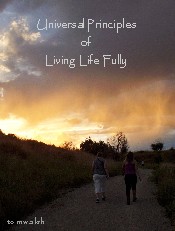
inspiring and motivational books that may interest you. Our main way of supporting this site is
through the sale of books, either physical copies
or digital copies for your Amazon Kindle (including the
online reader). All of the money that we earn
through them comes back to the site
in one way or another. Just click on the picture
to the left to visit our page of books, both fiction and
non-fiction!
Everything
in our lives reflects our consciousness. Our
beliefs, attitudes, expectations, feelings, and
emotional patterns are all mirrored in the circumstances
and events of our lives. For example, if I am very
critical of myself, I'm likely to attract and be
attracted to people who mirror that internal process by
being critical of me as well. The more I love and
support myself emotionally, the more likely I am to
attract loving, supportive behavior from others.
If I feel that life offers me few opportunities,
I'm likely to find that to be true in reality. If
I have confidence in my abilities, on the other hand, I
will probably discover many opportunities to use them.
Money can represent many things to us:
security
validation
freedom
temptation
abundance
power
recognition
opportunity
evil
happiness
status
worthiness
success
greed
prosperity
Our
financial circumstances will reflect how we feel about
the qualities we consciously or unconsciously associate
with money.
If on a deep level we feel unworthy of success or
happiness, we may unconsciously prevent ourselves from
having much money. Or, if we are deeply insecure,
and money represents power and status, we may be
compulsively driven to accumulate wealth in the hope
that it will bring us the security and validation we
yearn for. Yet, at some point, we may lose it
all. Seemingly a disaster, this may in fact be our
soul's way of setting up an opportunity to become
conscious of our deep feelings of inadequacy so we can
heal them. Money, or the loss of it, can be a
powerful catalyst for our growth and healing.
How does this differ from the popular New Age idea that
if we become aware of our negative thoughts and beliefs
about money and change them, our financial circumstances
will shift to reflect our changed consciousness and we
will become wealthy?
First, I am not talking about simply "changing our
thoughts." For a real shift to take place in
our lives, we must become aware of our core beliefs and
our deep emotions--especially the ones that have been
unconscious. We must be willing and able to heal
ourselves, not just on the mental level, but on the
spiritual, emotional, and physical levels as well.
Healing ourselves on the spiritual level involves
developing a strong connection with our soul. We
heal ourselves on the mental level as we become aware of
our core beliefs, release those that limit us, and open
to more supportive ideas and greater
understanding. Emotional healing takes place as we
learn to accept and experience the full range of our
feelings. And we heal ourselves on the physical
level when we learn to honor and care for our bodies,
and for the physical world around us.
Most of the limiting patterns in our lives are rooted in
deep emotional wounds that require a certain amount of
time and attention to heal. Even more profound is
the spiritual emptiness many of us feel when we
experience disconnection from our soul. We can
only heal this emptiness by finding a way to reconnect
with our spiritual essence.
We are unlikely to achieve real prosperity, financial or
otherwise, until we are able to feel comfortable in our
physical bodies and know how to operate in the material
world, as well.
So there are many aspects to the healing process.
This kind of transformation is no simple matter.
In fact, it is a gradually unfolding process that lasts
our entire lifetime. For most people, it is not
enough just to say positive affirmations about
prosperity, although that may be one very good step.
I have a problem with the idea that if we only believe
it possible, we can all have unlimited wealth.
Perhaps this is true in some ideal, theoretical
way. I believe, however, that our souls choose to
come into physical life in order to learn and develop in
certain ways, and that each of us has a unique
journey. Some of us may have chosen to experience
extreme physical limitation in this life through an
illness or disability, in order to deepen a certain
aspect of our strength and wisdom. Similarly, some
of us may choose to experience financial limitation at
times in our life, or for an entire lifetime, in order
to develop certain other aspects of our character.
Often these choices are made on a soul level and we are
completely unaware of them. On the level of
personality, we might feel quite frustrated and unhappy
about the circumstances of our lives until we've done
enough healing and consciousness work to begin to
understand how our soul's choice is serving us.
Remember that no matter what our level of income, we
have the opportunity to develop an experience of true
prosperity. Generally, both our relationship with
money and our experience of prosperity will develop as a
reflection of our healing and growth on all levels.
Living
Life Fully, the e-zine
exists to try to provide for visitors of the world wide web a
place
of growth, peace, inspiration, and encouragement. Our
articles
are presented as thoughts of the authors--by no means do
we
mean to present them as ways that anyone has to live
life. Take
from them what you will, and disagree with
whatever you disagree
with--just know that they'll be here for you
each week.
We
need to find God, and he cannot be
found in noise and restlessness. God is
the friend of
silence. See how nature--trees, flowers, grass--grow in
silence;
see the stars, the moon and sun, how they move in
Silence. . . . The more we receive
in silent prayer, the
more we can give in our active life. We need silence
to be
able to touch souls.
I
like the word "value," for it's a pretty
strange word when all is said and done. We use it
for shopping, of course, and who among us doesn't try to
find "a great value" when we go out to buy
things? Advertisers tell us that we can find the
best values at their stores or with their
products. The word also implies worth, as in being
worthwhile, or being worthy, and being of higher
quality. A cheaper product is of no worth to us if
it breaks apart an hour after we buy it; therefore, the
more expensive product probably would have been the
better value (though experience tells me that higher
price almost never automatically means higher quality).
But the word is also a verb, which we use when we want
to say how much we appreciate and care about
something. When I say that "I value his
friendship," it means that the friendship is very
important to me. If I change the wording slightly
and say that "I value him as a friend," then
I'm acknowledging his importance to me--he is what I
value most greatly, not necessarily the friendship.
Authentic
values are those by which a life
can be lived, which can form a people
that produces great deeds and thoughts.
Allan
Bloom
It's when we use the word as a verb that we truly can
get an idea of ourselves and other people, for when we
understand what people value, we understand much more
about them as people.
When I find out that someone values honesty very highly,
I'm attracted to that person, for I've learned through
experience that I can trust such people quite deeply,
and trust is very important to me. And because I
value trust, a person who values dishonesty in his or
her life isn't at all attractive to me--I'll always keep
such a person at a bit of a distance. It's a
protective instinct that causes me to do so, since I
don't want to end up being a victim of another person's
dishonesty. It's happened before, and I want to
try to avoid allowing it to happen again.
But what are the qualities that we truly value?
And once we find them, do we truly live by what we
value? If I value peace of mind but I constantly
put myself in situations that rob me of that peace, am I
allowing myself to live my life fully? Or am I
creating cognitive dissonance, a feeling inside that
something isn't right, a lack of comfortable connection
between what I know to be right for me and the reality
I'm experiencing?
Our
society's values are being corrupted by advertising's
insistence
on the equation: Youth equals popularity,
popularity
equals success, success equals happiness.
John
Arbuthnot Fisher
Once I identify what I value, it's very important that I
try to create situations and conditions in which I can
allow those things to be guiding forces in my
life. If I value honesty but hang around with
dishonest people, then I'm not allowing the thing I
value to be an integral part of who I am. If I
value solitude but never give myself a chance to be
alone, then I'm sabotaging my chances of experiencing
something that's important to me.
For example, one of the things I value the most in life
is being well rested. I know that I work better, I
feel better, and I relate better to others when I'm not
tired. Because this is something that I value very
highly, I'm more than willing to sacrifice other things
to make sure that I get rest when I need it.
That's not to say that I don't go all out when I do
things--I often work 14-16 hour days as a teacher and
coach. But when I feel the need for rest coming
on, I honor that need because I value it so highly.
Unfortunately, one of the places where we often pay the
least attention to our values is in the field of
relationships. How often are we willing to
compromise on our values because we care for
someone? If I value honesty and I'm having a
relationship with someone who doesn't, then I have to
admit that something that is very important to me is
being pushed out of my life by my own decisions.
We see over and over again how people are willing to
push their values aside just for the chance to escape
loneliness, starting relationships without the benefit
of shared values, and these relationships very often are
toxic.
Values
are principles and ideas that bring meaning to
the seemingly mundane experience of life. A meaningful
life that ultimately brings happiness and pride requires
you to respond to temptations as well as challenges
with honor, dignity, and courage.
Laura
Schlesinger
Which things do you value highly? Here's a good
starting list, compliments of Michael DeBakey:
"Real
success requires respect for and faithfulness to the highest
human values--honesty, integrity, self-discipline, dignity,
compassion, humility, courage, personal
responsibility, courtesy, and human service."
Here he's using these words as nouns to indicate values,
but are you able to say "I truly value personal
responsibility"? If you are, then you're
taking these nouns and making them important parts of
your life.
It's almost impossible to live our lives fully if we're
not aware of what we value, and if we don't allow
ourselves to live up to those values. It's very
easy to get caught up in life and spend our time
reacting to things that happen to us; it's more
important that we take the time to identify what we
value, and do our best to make sure that we create
situations and conditions that are favorable for living
up to them.
Children
learn about the nature of the world from their
family. They learn about power and about justice,
about
peace and about compassion within the family.
Whether
we oppress or liberate our children in our
relationships
with them will determine whether they grow
up to oppress
and be oppressed or to liberate and be
liberated.
You’re tense, tired,
edgy, perhaps even angry, hurt or feeling abused. But before
dealing directly with the source of whatever provoked your
feelings, get yourself into a more balanced and resourceful state
of mind. Then you will be able to see your situation more
objectively and work on a more permanent solution. Here are four
easy ways to pivot:
Take a Break.
No matter how
difficult the situation may appear to be, a change of pace can
help you open up new ways of looking at the problem. Stop what
you’re doing and find something else to do. Focus your mind on
anything but the cause of your stress. For example, if you’re
working on a stressful task, find another task to work on.
Practice Deep Breathing.
Breathing! It's one of the
simplest yet most effective ways to manage stress's effects on
your body. When you’re stressed, you have a tendency to
breathe more shallowly and rapidly – some people even hold
their breath – depriving your body of vital oxygen. To promote
a relaxation response, breathe slowly and deeply.
Work It Off Physically.Physical activities like
stretching, walking or yoga can help relax both your mind and
your body. Even a five- or ten-minute movement break can go a
long way toward helping your body reduce the tension caused by
stress.
Appreciate What’s Working.
The more you focus on
problems, the more stressed out you’ll feel. Likewise, the
more you dwell on what’s working, the better you’ll feel.
Review in your mind or make a list of everything that’s
"right" with your job. You may discover that you
can’t be in a stressed out state and an appreciative state at
the same time. For this reason, appreciation can be one of the
most powerful tools for easing tension and feeling better
immediately.
You may find that once
you release the tension and take your focus off the problem, the
solution will magically appear.
The
silence of
prayer is the silence
of listening.
Elizabeth
O'Connor
Yes, life
can be mysterious and confusing--but there's much of life that's
actually rather dependable and reliable. Some principles apply
to life in so many different contexts that they can truly be called
universal--and learning what they are and how to approach them and use
them can teach us some of the most important lessons that we've ever
learned.
My doctorate is in Teaching and Learning. I use it a lot when I
teach at school, but I also do my best to apply what I've learned to
the life I'm living, and to observe how others live their lives.
What makes them happy or unhappy, stressed or peaceful, selfish or
generous, compassionate or arrogant? In this book, I've done my
best to pass on to you what I've learned from people in my life,
writers whose works I've read, and stories that I've heard.
Perhaps these principles can be a positive part of your life, too! Universal Principles of Living Life Fully. Awareness of
these principles can explain a lot and take much of the frustration
out of the lives we lead.
Explore all of our
quotations pages--these links will take you to the first page of each
topic, and those pages will contain links to any additional pages on
the same topic (there are five pages on adversity, for example).






 ™
™