|
27 July 2026
| |
|
|
| |
|
Simple and Profound
Thoughts
(from Simple
and Profound) |
|
Love
doesn't just sit there,
like a stone--it has to be made, like bread;
re-made all the
time, made new. -
Ursula
K. LeGuin
|
Tolerance
is a better guarantee of freedom than brotherly love; for people
may love their brothers so much that they feel themselves thereby
appointed their brothers' keepers. -
Everett
Dean Martin
|
|
The
tragedy of life is not death but in what dies inside a person
while he or she lives--the death of genuine feeling, the death of
inspired response, the death of awareness that makes it possible
to feel the pain or the glory of other people in oneself.
-
Norman
Cousins
|
The habit
of always putting off an experience until you can afford it, or
until the time is right, or until you know how to do it is one of
the greatest burglars of joy. Be deliberate, but once you've
made up your mind--jump in. -
Charles R.
Swindoll
|
|
| |
|

|
| |
|
From
The Wayfarer on the Open Road
Ralph Waldo Trine
12.
To know that it is the middle ground that brings
pleasure and satisfaction, and that excesses have to be
paid for ofttimes with heavy and sometimes with frightful
costs.
ALL
things, good in themselves, are for use and enjoyment; but
all things must be rightly used in order that there may be
full and lasting enjoyment.
A law written into the very fibre of human life, so
to speak, is to the effect that excesses, the abuse of
anything good in itself, will end disastrously, so that
one's pleasures and enjoyments will have to be gathered up
for repairs, or perchance his shattered mind or body also,
and in case of the latter then the former will have to
bide their time or wait indefinitely for their resumption.
Wise
indeed is he who fully recognizes this law that never has
and that never will allow itself to be violated or undone,
but that will shatter, sometimes with telling and open
blows, more often perhaps with blows subtle and guarded,
but just as telling, the happiness or even the mind and
the body of the one who would do violence to or who would
fail to recognize its mandate— Moderation.
On
the other hand, to see evil in things good in themselves
is the perversion of another law that carries with it its
own peculiar penalty.
The one tends to make the prig, the self-righteous,
out of a good, wholesome man or woman, the same as the
other makes eventually the voluptuary.
|

|
|
The one errs in the one direction the same as the
other in another direction. Each pays the penalty for his folly, the one by cutting
himself off from much innocent and valuable God intended
enjoyment, at the same time casting a continual shadow
over the lives of others; the other by way of settling
heavy bills of costs for his excesses.
It
should be then neither license nor perverted use on the
one hand, nor asceticism or priggishness on the
other—the full use of all normal and natural functions,
faculties, and powers, innocent and good in themselves,
that all may be brought to their fullest growth and
development, but never excessive or perverted use.
The
tendency of the great majority, especially in our
present-day American life, is on the side of the too
serious, the too busy, the too absorbing in the business,
in the work. This
induces all unconsciously, in time, a prevailing type of
thought and mental activity that takes, so to speak, the
buoyancy, the elasticity out of both mind and body, so
that age and its accompanying features manifest, assert,
and fix themselves in many, or to speak more truly, in the
majority of cases, long before their time.
By way of balance, by way of disarming these, we
need more of the play element, more of the open air, the
sunshine, the exercise element in our lives.
It would save thousands from stiffening of joints
and muscles, hardened arteries, dyspepsia, apoplexy, nerve
exhaustion, melancholia, premature age, premature death.
''Happy
recreation has a very subtle influence upon one's ability,
which is emphasized and heightened and multiplied by it.
How our courage is braced up, our determination,
our ambition, our whole outlook on life changed by it!
There seems to be a subtle fluid from humor and fun
which penetrates the entire being, bathes all the mental
faculties, and washes out the brain-ash and debris from
exhausted cerebrum and muscles. . . . A joyful, happy,
fun-loving environment develops powers, resources, and
possibilities which would remain latent in a cold, dull,
repressing atmosphere."
Look
where we will, in or out and around us, we will find that
it is the middle ground—neither poverty nor excessive
riches, good wholesome use without license, a turning into
the bye-ways along the main road where innocent and
healthy God-sent and God-intended pleasures and enjoyments
are to be found; but never getting far enough away to lose
sight of the road itself. The middle ground it is that the
wise man or woman plants foot upon.
|
|
more
thoughts and ideas on recreation
|
|
| |
|
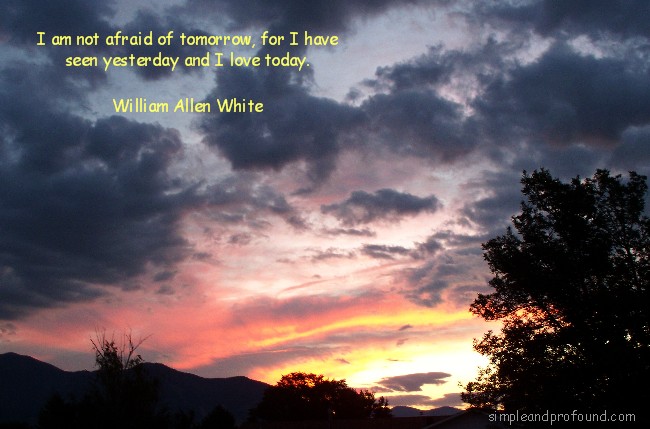
(Simple and Profound is now a
part of this site. Visit by clicking
here.)
|
|
quotations
- contents
-
welcome
page
-
obstacles
- weblog
the
people behind the words
-
our
current e-zine
-
articles
and excerpts
Daily
Meditations, Year One - Year
Two - Year Three
- Year Four
Simple
and Profound website
Sign up for your free email daily
spiritual or general quotation
Sign
up for your free email daily meditation
|
| |
|

|
We
have some
inspiring and motivational books that may interest you. Our main way of supporting this site is
through the sale of books, either physical copies
or digital copies for your Amazon Kindle (including the
online reader). All of the money that we earn
through them comes back to the site
in one way or another. Just click on the picture
to the left to visit our page of books, both fiction and
non-fiction! |
|
| |
|

|
| |
Pearls
of Wisdom
(an excerpt)
Rachel Naomi Remen
Some
of the oldest and most delightful written words in
the English language are the collective nouns dating
from medieval times used to describe groups of birds
and beasts. Many of these go back five hundred
years or more, and lists of them appeared as early
as 1440 in some of the first books printed in
English. These words frequently offer an
insight into the nature of the animals or birds they
describe. Sometimes this is factual and
sometimes poetic. Occasionally it is
profound: a pride of lions, a party of jays,
an ostentation of peacocks, an exaltation of larks,
a gaggle of geese, a charm of finches, a bed of
clams, a school of fish, a cloud of gnats, and a
parliament of owls are some examples. Over
time, these sorts of words have been extended to
other things as well. One of my favorites is
pearls of wisdom.
An
oyster is soft, tender, and vulnerable.
Without the sanctuary of its shell it could not
survive. But oysters must open their shells in
order to "breathe" water. Sometimes
while an oyster is breathing, a grain of sand will
enter its shell and become a part of its life from
then on.
Such
grains of sand cause pain, but an oyster does not
alter its soft nature because of this. It does
not become hard and leathery in order not to
feel. It continues to entrust itself to the
ocean, to open and breathe in order to live.
But it does respond. Slowly and patiently, the
oyster wraps the grain of sand in thin translucent
layers until, over time, it has created something of
great value in the place where it was most
vulnerable to its pain. A pearl might be
thought of as an oyster's response to its
suffering. Not every oyster can do this.
Oysters that do are far more valuable to people than
oysters that do not.
Sand
is a way of life for an oyster. If you are
soft and tender and must live on the sandy floor of
the ocean, making pearls becomes a necessity if you
are to live well.
Disappointment
and loss are a part of every life. Many times
we can put such things behind us and get on with the
rest of our lives. But not everything is
amenable to this approach. Some things are too
big or too deep to do this, and we will have to
leave important parts of ourselves behind if we
treat them in this way. These are the places
where wisdom begins to grow in us. It begins
with suffering that we do not avoid or rationalize
or put behind us. It starts with the
realization that our loss, whatever it is, has
become a part of us and has altered our lives so
profoundly that we cannot go back to the way it was
before.
Something
in us can transform such suffering into
wisdom. The process of turning pain into
wisdom often looks like a sorting process.
First we experience everything. Then one by
one we let things go, the anger, the blame, the
sense of injustice, and finally even the pain
itself, until all we have left is a deeper sense of
the value of life and a greater capacity to live it.
|
|
| |
|
|
|
Living
Life Fully, the e-zine
exists to try to provide for visitors of the world wide web a
place
of growth, peace, inspiration, and encouragement. Our
articles
are presented as thoughts of the authors--by no means do
we
mean to present them as ways that anyone has to live
life. Take
from them what you will, and disagree with
whatever you disagree
with--just know that they'll be here for you
each week. |
|
| |
|
Why do we protect children from life?
It's no wonder that we become afraid to live.
We're not told what life really is. We're not told that life
is joy and wonder and magic
and even rapture, if you can get involved enough.
We're not told that life is also pain,
misery, despair, unhappiness, and tears. I don't know
about you, but I don't want
to miss any of it. I want to embrace life, and I want
to find out what it's all about.
I wouldn't want to go through life without knowing what it
is to cry.
Leo
Buscaglia
|
| |
|
It's
Okay to Start Over with Something Different
I
started writing another article about a completely
different topic yesterday, but between then and now,
the article simply hasn't happened. I wrote
three paragraphs that I didn't like, then I felt
stuck--mostly, I think, because I didn't like what I
had written. Where was I going to go from
there?
I looked at those three paragraphs for several
minutes, wondering what I could write next, wanting
to continue because I had already started and I had
a title written and everything. Much of the
programming I went through as a young person had
taught me something along the lines of "never
give up what you started," and to look for ways
to make something work that just wasn't working.
So I put into play another lesson that I've learned
in life, and I highlighted the three paragraphs and
deleted them. Then I rewrote the title to the
one you see now, and I started writing something
completely different.
Did I "give up"? No, I didn't--or
perhaps I did, but the term simply isn't as negative
as some people make it out to be. Sometimes
it's good to give up on things that just aren't
working out--another term for doing say may be
"moving on," or even "getting
smarter." I've learned in life, though,
that we don't always have to finish something just
because we started it, and that doesn't matter if
it's an article, a movie, a relationship, a college
course, or a sporting season. There are times
when the decision to stop doing a particular thing
because it makes no sense to continue is the best
thing that we can do, as long as it doesn't unduly
harm someone else.
There have to be limits, of course. If I
commit to a full season of a sport, and my leaving
the team would cause the rest of the players not to
be able to compete any longer, then I most certainly
would honor my commitment. If I'm taking a
college course because my work is paying for it and
they need more people to have finished the course,
then I'll finish it. If I promised to tutor a
young person all through a quarter or semester to
help them pass a course and that person has been
trying hard, then I'll continue as best I can.
But an awful lot of things in our lives are okay to
give up, especially when doing so can help us to
grow and develop as a person as we take on other
challenges that may be more appropriate and more
fulfilling. I might have taken a job that is
miserable, or that pays more poorly than I thought,
or in which I'm abused as a worker. It's not
necessary to stay on that job, and it's fine to look
for another one. Perhaps I married someone who
turned out to be completely different than they were
before we got married; it may be time to walk away
from the marriage and begin life anew.
Two things are important: First, the fact that
we've made a decision to end a project or a
relationship or a job doesn't mean that we've failed
or that we're doing something wrong. We have
our individual lives to live, and we know what's
best for us, and it's important to listen to our
hearts to know what's right and what's wrong.
Other people cannot tell us what's right or wrong
for us if they aren't walking in our shoes and
living in our skin. Second, ending something
like a job or a relationship isn't the end of the
world. Rather, it's an opportunity to restart
and to make our lives more positive and more loving
as we recover from the negative experiences that
caused us to walk away in the first place. If
we're stuck in a negative situation, after all,
there's a good chance that we're unable to help
others and to give to the world in ways that we're
capable of.
It really is okay to say "enough."
It's okay to leave a situation and to move on.
We don't want to make it a habit, and we do want to
try to make things better before we decide to let it
go, but leaving certain situations may be exactly
what our souls need in order to flourish, to grow,
to expand. This by no means signifies that we
should make a habit of running away from situations
rather than dealing with them--for that habit causes
a ton of problems of its own--but I've learned that
sometimes, the best thing that I can do is to walk
away from a situation, to let it go and to move on.
|
|
|
|
|
|
|
| |
|
|
| |
|
 ™ ™
|
|
All contents
© 2026 Living Life Fully™,
all rights reserved.
Please feel
free to re-use material from this site other than
copyrighted articles--
contact each author for permission to use those.
If you use material, it would be
greatly appreciated if you would provide credit and
a link back to the original
source, and let us know where the material is
published. Thank you. |
|
| |
|
|
|
Young people say, What is the sense of our small
effort? They
cannot see that they must lay one brick at a time;
we can be
responsible only for the one action
at the present moment. But
we can beg
for
an increase of love in our hearts that will
vitalize
and transform all
our individual actions,
and know
that God will take them and multiply them,
as Jesus
multiplied the loaves and fishes.
Dorothy Day
|
|
| |
|
On
Strength
Kent Nerburn
We each have
a different kind of strength. Some of us are able to persevere
against hopeless odds. Some are able to see light in a world
of darkness. Some are able to give selflessly with no thought
of return, while others are able to bring a sense of importance into
the hearts of those around them.
But no matter
how we exhibit strength, its truest measure is the calm and certain
conviction with which it causes us to act. It is the ability
to discern the path with heart, and follow it even when at the
moment we might wish to be doing something else.
True strength
is not about force, but about conviction. It lives at the
center of belief where fear and uncertainty cannot gain a
foothold. Its opposite is not cowardice and fear, but
confusion, lack of clarity, and lack of sound intention.
True strength
does not require an adversary and does not see itself as noble or
heroic. It simply does what it must without praise or need of
recognition.
A person who
can quietly stay at home and care for an ailing parent is as strong
as a person who can climb a mountain. A person who can stand
up for a principle is as strong as a person who can fend off an
army. They simply have quieter, less dramatic, kinds of
strength.
True strength
does not magnify others' weaknesses. It makes others
stronger. If someone's strength makes others feel weaker, it
is merely domination, and that is no strength at all.
Take care to
find your own true strength. Nurture it. Develop
it. Share it with those around you. Let it become a
light for those who are living in darkness.
Remember,
strength based in force is a strength people fear. Strength
based in love is a strength people crave.
|
Goodness
Knows
Goodness knows that
sometimes the greatest thing
in the world is a smile from a child,
So Goodness laughs a lot.
Goodness knows that it's
easier to break a child than to mend one,
So Goodness handles with care.
Goodness knows that
everyone deserves a second chance,
And sometimes a third and fourth chance, too.
Goodness knows that we
all need friends in this world,
So Goodness is determined to be friendly.
Goodness knows that only
people count,
So Goodness never counts out people.
Goodness knows that life
is sometimes lonely,
But we are never alone.
And when the sorrows of
life are left unexplained,
it's still not too much to bear,
For we can trust that Goodness knows.
--unattributed
|
|
| |
|
|
|
| |
|
Listen
to your life. See it
for the fathomless mystery
that it is. In the boredom
and pain of it no less than
in the excitement
and
gladness: touch, taste,
smell your way to the holy
and
hidden heart of it,
because in the last analysis
all moments
are key
moments,
and life itself is grace.
Frederick
Buechner
|
| |
|