Many years ago when I was a teaching
pediatrician at a major medical school, I
followed six young teenagers with juvenile
diabetes. Most of them had diabetes since
they were toddlers and had responsibly followed
strict diets and given themselves injections of
insulin since kindergarten. But as they
became caught up in the turmoil of adolescence,
desperate to be like their peer group, this
disease had become a terrible burden, a mark of
difference. Youngsters who had been in
diabetic control since infancy now rebelled
against the authority of their disease as if it
were a third parent. They forgot to take
their shots, ate whatever the gang ate, and were
brought to the emergency room in coma or in
shock, over and over again. It was
frightening and frustrating, dangerous for the
youngsters and draining for their parents and
the entire pediatric staff.
As the associate director of the clinics, this
problem was brought to my door and I decided to
try something simple. I formed two
discussion groups, each consisting of three
youngsters and the parents of the other
three. Each group met to talk once a week.
These groups turned out to be very
powerful.
Kids who could not talk to their
own parents became articulate in expressing
their needs and perspectives to the parents of
other children. Parents who could not
listen to their own children hung on every word
of other people's children. And other
people's children could hear them when they
could not hear their own parents. People,
feeling themselves understood for the first
time, felt safe enough to cry and found that
others cared and could comfort them.
People of all ages offered each other insights
and support, and behaviors began to
change. Parents and their own children
began to talk and listen to each other in new
ways. We were making great progress in the
quality of all the family relationships, and the
number of emergency room visits was actually
diminishing, when the director of the clinics
discovered the groups.
His indignation was painful. What was I
thinking of to overstep the limitations of my
expertise in such a blatant way? Was I a
psychiatrist? What if one of these people
had gotten hurt by something that was said, or
had become emotionally disturbed? What
would I have done then? Despite the good
results, the groups were disbanded.
There is still a very narrow conception of what
a health provider is. Thinking back on
some of those people and the wisdom, kindness,
and understanding they offered each other, I am
sad. They were not second-class
experts. And having been ill since
adolescence, neither was I. Our life
experience was as valuable as any credential.
I do not think that we will be able to attain
health for all until we realize that we are all
providers of each other's health, and value what
we have to offer each other as much as what
experts have to offer us. In the years
since, groups such as these have demonstrated
beyond question that problems which are not
amenable to the most expert medical approaches
may be resolved in community by the very people
who suffer from them and therefore understand
them. In such communities, the concept of
woundedness breaks down and we are all wounded
healers of each other. We have earned the
wisdom to heal and the ability to care.
In a recent talk, Bill Moyers commented that one
of the most traditional values of American
life--live and let live--can never establish
good health for all. Health requires us as
individuals and as a people to go a step beyond
this. To live and help live.
I’m like water flowing free across the ground
I dance upon the wings of a hurricane
This is my home, I follow my destiny
I’m the road, I am, I am, I am
To live by life’s light and give it a name
To flee from the chaos that consumes us
It doesn’t take much more
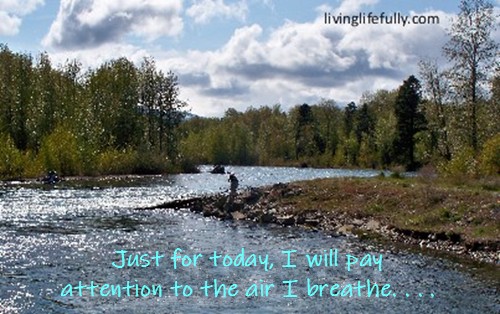
Than a minute looking at the sky and breathing
Chorus:
I’m going to breathe, I’m going to breathe
I’m going to breathe with an open heart
Wherever I go, I’ll carry love
In every breath I take
And if we consider
That we live together this much with so little
By the hands of the wind unite the whole world
The same air through the night and the day
To bring the melody every single morning
And fill our hearts with love at the break of dawn, oh-oh
Life gave me so much without asking for anything, and I didn’t even know,
Now I know that to show my gratitude
I’m going to breathe, I’m going to breathe
To make peace my home with an open heart
Oh, what a good life, dancing to this chorus every day
In this life, I’m the road
I’m the road, I’m the road
Original Portuguese:
Sou que nem água solta no chão
Danço nas asas de um furacão
Esta é a minha casa, sigo o destino
Eu sou a estrada, eu sou, eu sou, eu sou
Viver da luz da vida e dar-lhe um nome
Fugir da confusão que nos consome
Não é preciso muito mais
Do que um minuto a olhar o céu e respirar
Chorus:
Respirar, eu vou, respirar, eu vou
Respirar, eu vou, peito aberto (eu vou)
Seja onde for, eu vou levar amor
No meu respirar
E se pensarmos
Que vivemos juntos este tanto com tão pouco
Pelas mãos do vento faz-se unir o mundo todo
O mesmo ar, a noite e o dia
(repeat)
Trazer todos os dias de manhã a melodia
E encher o nosso peito de amor no amanhecer, oh-oh
A vida deu-me tanto sem cobrar e eu nem sabia
Agora eu sei que para agradecer
Chorus x 3
Fazer da paz uma morada, peito aberto
Ai, que boa vida, dançar este refrão a cada dia
Na vida, eu sou a estrada
Eu sou a estrada, eu sou a estrada
We
have some
inspiring and motivational books that may interest you. Our main way of supporting this site is
through the sale of books, either physical copies
or digital copies for your Amazon Kindle (including the
online reader). All of the money that we earn
through them comes back to the site
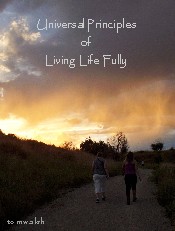
in one way or another. Just click on the picture
to the left to visit our page of books, both fiction and
non-fiction!
There is a little poem that reads,
"Two men looked through prison bars. One
saw the mud; the other saw the stars." The
moral: You can improve your ability to deal with
change by focusing your attention on the future
and by seeing the glass as half-full rather than
half-empty.
We certainly hear a lot about change these days.
A critical issue in dealing with change is the
subject of control. Most of your stress and
unhappiness comes as a result of feeling out of
control in a particular area of your life. If
you think about the times or places where you
felt the very best about yourself, you will
realize that you had a high degree of control in
those places. One of the reasons why you like to
get home after a trip is that, after you walk
through your front door, you feel completely in
control of your environment. You know where
everything is. You don't have to answer to
anyone. You can relax completely. You are back
in control.
Psychologists call this the difference between
an "internal locus of control" and an
"external locus of control." Your
locus of control is where you feel the control
is located for a particular part of your life.
People with an external locus of control feel
they are controlled by outside forces, their
bills, their relationships, their childhood
experiences, or their external environment. When
a person has an external locus of control, he or
she feels a high degree of stress. And with an
external locus of control, a person is very
tense and uneasy about change of any kind.
Change represents a threat that may leave the
individual worse off than before.
On the other hand, people with an internal locus
of control possess a high level of
self-determination. They feel that they are very
much in charge of their life. They plan their
work and work their plan. They accept a high
level of responsibility, and they believe that
everything happens for a reason and that they
are the primary creative force in their life.
Since the only thing over which you have
complete control is the content of your
conscious mind, you begin to deal with change by
taking full, complete control over the things
you think. As Aldous Huxley said,
"Experience is not what happens to you; it
is what you do with what happens to you."
Since change is inevitable and continuous, it is
how you think about what is happening to you
that is most important in determining how change
affects you — and whether you use it to your
advantage or let it work to your disadvantage.
In his book Celebrations of Life, Rene
Dubos wrote that we fear change more today than
ever before, and for less reason. The reason we
fear change is because we are afraid that we
will be worse off as a result. No one fears
change that implies improvement. For example, if
you learned that you were going to have to
change your lifestyle because you had just won
the lottery, this is not the kind of change that
you would avoid or anticipate with dread. It is
change that implies unpleasant surprises that
you fear and become anxious about, because it
causes you to feel that you have lost a certain
amount of control in that part of your life.
Your aim is to become a "change
master," to embrace change, to welcome
change, to ride the tides of change, and to move
toward the improvements you desire.
Boat builders know that the deeper the keel of a
sailing vessel, the more stable it will be in
storms, squalls, and gusts of wind. The same
holds true for you. The deeper your keel — or
stabilizing factors in your life — the less
likely it is that you will be blown over or off
course when unexpected change occurs.
You can deepen your keel and increase your
stability by setting big goals for yourself and
making clear, written plans for their
accomplishment. Goals enable you to control the
direction of change. With goals, change becomes
planned and deliberate, instead of random and
haphazard. Goals assure that the changes that
take place in your life are primarily
self-determined and self-directed. With clear,
specific goals, the changes that take place will
tend to be positive and move you toward
something that you want to achieve rather than
blow you off course.
It is inevitable that you will experience a
continuous series of large and small
disappointments and setbacks in your life. That
is the nature of the game. They are unavoidable.
Some things work out, and some things don't.
Sometimes you win; sometimes you lose. In spite
of your best efforts, unexpected and
unpredictable events will derail your best-laid
plans. This endless process of change and
setbacks begins when you first enter the
workforce, and it continues for the rest of your
career. Problems and changes in your work are
like the rain — they just happen. But if you
set clear goals for your work, as well as for
your family life and for your personal
development, then no matter what happens, you
can concentrate your thinking on your goals and
take a long-term view of your current
circumstances. You can, in effect, rise above
the challenges of the moment and keep your eyes
on the guiding stars of your life and your most
cherished dreams.
With clear goals, you will become
multidimensional rather than one-dimensional. A
setback or disappointment in any one part of
your work will be quickly offset by the fact
that you are busy in other areas, and you simply
won't allow yourself to invest too much
emotional energy in one particular thing that
doesn't work out to plan.
Now I'd like to share with you a four-step
method of dealing with change:
The first step is simply to
accept the change as a reality. Acceptance is
the opposite of rejection or resistance.
Acceptance keeps your mind calm and positive. As
William James said, "The starting point in
dealing with any difficulty is to be willing to
have it so." The minute you accept that a
change has occurred and that you can't cry over
spilled milk, you become more capable of dealing
with the change and turning it to your
advantage.
One of the best ways to deal with the worry that
is often generated by unexpected change is to
sit down and answer, on paper, the question:
"What exactly am I worrying about?"
In medicine, it is said that accurate diagnosis
is half the cure. When you sit down and define a
worrisome situation clearly on paper, it
suddenly becomes less stressful to you, and it
will often resolve itself. In any case, when it
is clearly defined, you have diagnosed it, and
you now can do something about it.
The second step is to ask
yourself, "What is the worst possible thing
that can happen as a result of this
change?" Much worry and stress comes from
the refusal to face what might happen as a
result of a difficult problem. When you clearly
define the worst possible outcome and write it
down next to the definition of the problem,
chances are you will find that, whatever it is,
you can handle it. Often, your worries will
begin to evaporate after you have determined the
worst that might happen as a result.
Now decide to accept the worst possible outcome
should it occur. Mentally resolve that, even if
the worst possible consequence ensues from this
situation, it will not be the end of the world
for you. You will accept it and carry on. The
very act of accepting the worst possible outcome
helps to eliminate the stress and anxiety
associated with the situation.
The third step in dealing with
change is adjusting your behaviors and actions
to the new situation. Ask yourself, "What
are all the things I can do to make sure that
the worst does not occur?" Sometimes we
call this "damage control." In the
business schools, this is an important part of
decision making, and it is called the
"mini-max regret solution." What can
you do to minimize the maximum damage that can
occur from an unexpected change or setback? As
you begin thinking of all the things you can do,
you are adjusting your mind to the new
information and preparing to take steps to deal
with the change effectively. Write these things
down next to the result of step two.
The final part of this
four-step method for dealing with change is to
improve on the existing situation. Often, a
change signals that your plans are incomplete or
that you might be heading in the wrong
direction. Serious changes, which create real
problems, are often signals that you are on the
wrong track. There is an old saying,
"Crisis is change trying to take
place." You will often find that the change
is a healthy and positive step toward achieving
your goals.
W. Clement Stone, the billionaire and founder of
Combined Insurance Company, was famous for his
attitude of being an "inverse
paranoid." He was convinced that everything
that happened to him was part of a conspiracy to
help him to be more successful. Whenever
something unexpected occurred, he immediately
said, "That's good!" and then looked
into the situation to find out exactly what was
good about it.
If you look into any change, you will always
find something good and beneficial for you. Look
for the valuable lessons contained within every
setback. What is the hidden advantage that you
can turn to your benefit? Is this change a
signal that, if properly responded to, will save
you from a much bigger change or problem in the
future? Since your mind can hold only one
thought at a time, if you force yourself to look
for the positive aspect of any change, you'll
keep your mind clear, and you'll keep your
attitude optimistic and confident.
Victor Frankl said that the last great freedom
of man is the freedom to choose his attitude
under any given set of circumstances. You cannot
control what happens to you, but you can control
your attitude toward what happens to you, and in
that, you will be mastering change rather than
allowing it to master you.
A mark of a successful person is what has been
called "tolerance for ambiguity." This
simply means that you have the capacity to deal
effectively with a rapidly changing situation.
The more successful you become — the greater
your income and responsibilities, the higher
your status and position — the faster the rate
of change that will be around you. At every
stage, it will be your ability to function with
calmness, clarity, and quiet assurance that will
mark you as the kind of person who is going
places in life.
In the final analysis, your ability to perform
effectively in a world of ongoing change is the
true measure of how well developed a person you
are. As you continue to do this, you will
experience a wonderful feeling of self-control
and self-determination that your whole life will
be bright and positive — and so will your
results.
Living
Life Fully, the e-zine
exists to try to provide for visitors of the world wide web a
place
of growth, peace, inspiration, and encouragement. Our
articles
are presented as thoughts of the authors--by no means do
we
mean to present them as ways that anyone has to live
life. Take
from them what you will, and disagree with
whatever you disagree
with--just know that they'll be here for you
each week.
When
we are relaxed and reasonable content, we are naturally wise. We
accept
that life is unpredictable, unreliable. We say jokingly or
philosophically, "Nothing is
sure except death and taxes," or God willing and the creek don't
rise," reminding
each other that, notwithstanding the level of planning, we are
continually dealing
with being surprised. We get startled. We recover.
We are disappointed.
We adjust. Mostly--with Wisdom intact--we manage.
I sometimes have
a difficult time convincing students that they have
strengths. Many young people, after consistent battering
from their families and friends about all the things that they're
doing wrong, simply lose the ability to see that there are
many, many more things that they're able to do right.
Because feedback from others is one of the most important
formative elements of our young lives, so often what sticks with
us are the corrections that tell us that we don't measure up to
expectations.
But we all have strengths. We all have elements of our lives
that come naturally to us, that we do very well naturally--and if
we work at improving our abilities in those areas, we definitely
will become experts. I work with many students who have a
very difficult time distinguishing between a noun and a pronoun,
yet who are able to analyze a complicated piece of literature and
share its meanings as if it were a three-sentence fable.
We
all have strengths and weaknesses. The best advice
is to embrace, focus on, and nurture our strengths.
Unless, of course, those strengths include exploiting the
weaknesses of others. Then I suggest discovering new
ones.
Charles F. Glassman
Unfortunately, in our educational systems, we take a student like
that and say "This guy can't distinguish between parts of
speech, so let's spend the whole year working with him until he's
able to do so."
But what would happen if we were to say, "This guy can't
distinguish between nouns and pronouns, but he's great at
analyzing literary works. Let's keep working with him on the
parts of speech, but let's focus primarily on his literary
analysis skills--after a year of work, he's going to be among the
best in his age group at that skill."
What would happen if we did this with all our young people?
What would have happened if people had done this with us when we
were young?
If
you spend your life trying to be good at
everything, you will never be great at anything.
Tom Rath
I have a hunch that I know what would have happened if this had
been our approach all along in education. Fewer bored
students. More engagement in classes. Higher senses of
accomplishment and self-esteem. More extremely well
qualified students coming out of our school systems.
But that's all theory. What concerns me right now is the
reality of the right now--you and I also have problems with
ourselves and our strengths and weaknesses. Sometimes we
focus so strongly on the things that we do wrong that we neglect
our strong points. Sometimes we get so caught up in doing
the work that we do--which may or may not be among our
strengths--that we don't even try to improve our skills or
knowledge in our strength areas.
“Play
to your strengths."
"I haven’t got any," said Harry, before he could stop
himself.
"Excuse me," growled Moody, "you’ve got strengths
if I say you’ve got them. Think now. What are you best at?”
J.K. Rowling, Harry Potter and the Goblet
of Fire
What are your strengths? What are your passions? What
would it take for you to get much, much better in a strength
area? Could you grow stronger if you were to practice
or study for 30 minutes a day? Sixty minutes? The
answer there is, most definitely. But then the next question
becomes, then why don't we give that time to becoming better at
what we're good at?
I want. .
. to endeavor to speak
truth in every instance;
to give nobody
expectations that
are not likely to be answered,
but aim at sincerity
in every word
and action--the most amiable
excellence in a rational
being.
Benjamin
Franklin
Things
to Do
Sing a new
song; dance a new step; take a new path.
Think a new
thought; accept a new responsibility; memorize a new poem.
Try a new
recipe; plan a new adventure; entertain a new idea.
Learn a new
language; blaze a new trail; enjoy a new experience.
Make a new
fiend; read a new book; see a new movie.
Climb a new
hill; scale a new mountain; launch a new career.
Find a new
purpose; fill a new need; light a new lamp.
Exercise a
new strength; grasp a new truth; practice a new awareness.
Add a new
dimension; encourage a new growth; affirm a new beginning.
Discover a
new answer; envision a new image; conceive a new system.
Dream a new
dream; chart a new course; build a new life.
Open a new
door; explore a new possibility; capture a new vision.
Start a new
chapter; seek a new challenge; express a new confidence.
Write a new
plan; turn a new page; follow a new direction.
Watch a new
program; be a new person; radiate a new enthusiasm.
William Arthur Ward
Failures
'Tis better to have tried in vain,
Sincerely striving for a goal,
Than to have lived upon the plain
An idle and a timid soul.
'Tis better to have fought and spent
Your courage, missing all applause,
Than to have lived in smug content
And never ventured for a cause.
For those who try and fail may be
The founders of a better day;
Though never theirs the victory,
From them shall others learn the way.
Edgar Guest
The best things are nearest: breath in
your nostrils, light in your eyes, flowers at
your feet,
duties at your hand, the path of God just before you. Then do not
grasp at the stars,
but do life's plain,
common work as it comes, certain that
daily duties and
daily bread
are the sweetest things of life.
Robert Louis Stevenson
Yes, life
can be mysterious and confusing--but there's much of life that's
actually rather dependable and reliable. Some principles apply
to life in so many different contexts that they can truly be called
universal--and learning what they are and how to approach them and use
them can teach us some of the most important lessons that we've ever
learned.
My doctorate is in Teaching and Learning. I use it a lot when I
teach at school, but I also do my best to apply what I've learned to
the life I'm living, and to observe how others live their lives.
What makes them happy or unhappy, stressed or peaceful, selfish or
generous, compassionate or arrogant? In this book, I've done my
best to pass on to you what I've learned from people in my life,
writers whose works I've read, and stories that I've heard.
Perhaps these principles can be a positive part of your life, too! Universal Principles of Living Life Fully. Awareness of
these principles can explain a lot and take much of the frustration
out of the lives we lead.
Explore all of our
quotations pages--these links will take you to the first page of each
topic, and those pages will contain links to any additional pages on
the same topic (there are five pages on adversity, for example).








 ™
™